


Why AI transparency is critical for executive adoption, regulatory compliance, and corporate risk reduction
THE PROBLEM WE ALL FACE
Imagine this scene: you’re in the boardroom, ready to present a critical five-million-euro decision based on recommendations generated by artificial intelligence. The CFO looks at you and asks with a calm but incisive tone: “Why exactly does the algorithm suggest this investment?”
You respond, perhaps with a hint of uncertainty: “That’s what the AI says.”
The CFO isn’t satisfied and insists: “But on what basis? Which factors did it consider? How exactly did it arrive at this conclusion? Can we trust it?”
And here falls an uncomfortable silence.
This scene repeats itself every day in thousands of companies worldwide. It’s the fundamental problem of so-called “black boxes” in artificial intelligence. And in 2025, with the progressive implementation of the EU AI Act and growing scrutiny from regulators, investors, and consumers on automated decisions, this lack of transparency is no longer acceptable. It’s no longer a technical problem relegated to data scientists, but has become a strategic issue involving boards, compliance officers, executive teams and, ultimately, the company’s reputation itself.
WHAT EXPLAINABLE AI REALLY IS
Explainable AI, often abbreviated as XAI, is not simply a set of techniques to “show the calculations” of artificial intelligence. It’s something much deeper and more strategic: it represents the set of methods, approaches, and technologies that make the results and decisions of AI systems comprehensible to humans. But careful: comprehensible not only in a technical sense, but in a way that is interpretable, relevant, and above all actionable for the stakeholders who must trust those decisions and act accordingly.
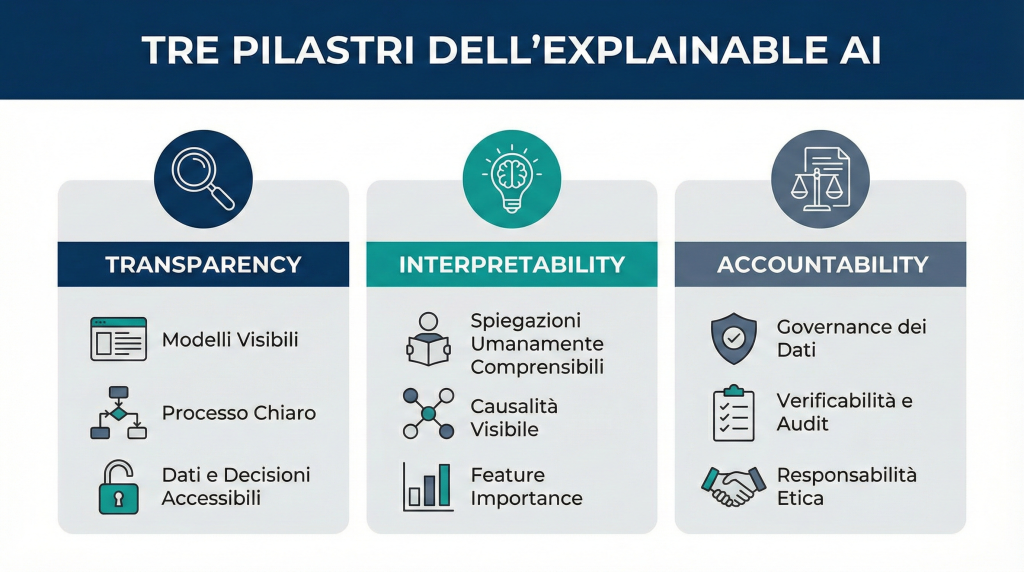
When we talk about Explainable AI, we refer to three fundamental pillars that must coexist. The first is transparency, which means having complete visibility into how the model works, access to the data it was trained on, understanding of the features it uses, and exhaustive documentation of the implemented AI architecture. The second pillar is interpretability, or the ability to understand why a specific output was generated, what the clear correlations are between the inputs provided and the outputs received, and how to translate the decision logic into terms that make sense in the business context. The third and final pillar is accountability, which implies maintaining a complete audit trail of every decision made by the system, ensuring the possibility of contesting or correcting outputs that prove incorrect, and ensuring clear attribution of responsibilities distinguishing what is human from what is algorithmic.
WHY EXPLAINABILITY HAS SUDDENLY BECOME CRITICAL
In the last two years we’ve witnessed a radical paradigm shift. What until recently was considered a technical “nice-to-have” has now become a strategic, regulatory, and business imperative. Three main factors are driving this transformation.
The Regulatory Revolution: The EU AI Act Changes the Rules of the Game
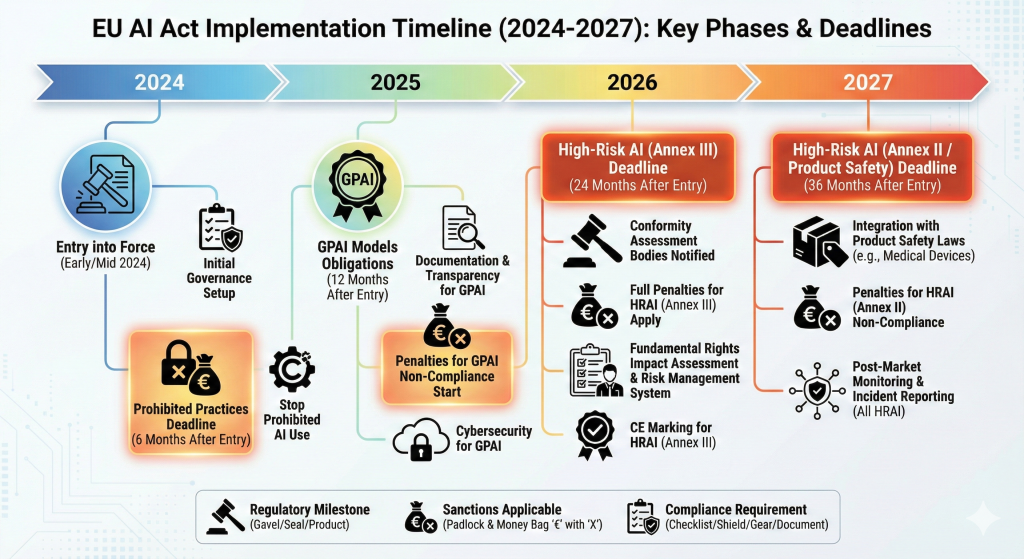
Europe has decided to take control of the artificial intelligence issue with an approach that is already influencing the global landscape. The EU AI Act, progressively implemented starting in 2024, imposes stringent transparency obligations for all AI systems considered high-risk. And when we talk about high-risk systems, we’re not referring to science fiction scenarios, but to everyday situations affecting thousands of European companies.
This category includes credit decisions and all automated financial services, recruiting systems and employee performance evaluations, scoring mechanisms used by insurance companies, decisions in the healthcare sector that influence diagnoses or treatments, and even some systems used by law enforcement. The penalties for non-compliance are far from symbolic: we’re talking about fines that can reach up to thirty-five million euros or seven percent of annual global turnover, whichever is greater. But beyond fines, there’s the concrete risk of having authorization to operate in the European Union revoked, not to mention civil liability for any damages caused by non-compliant systems.
The specific requirements demanded by the regulation are precise and detailed. Companies must produce complete and updated technical documentation, clearly inform users when they are interacting with an artificial intelligence system, ensure human oversight of all high-impact decisions, and provide detailed explanations of individual decisions whenever requested by affected parties.
The Trust Factor: Why Leaders Hesitate
There’s an interesting paradox that emerges from the most recent data on AI adoption in companies. On one hand, about sixty-five percent of C-suite executives consider AI a strategic priority for their organization. On the other hand, only twenty-eight percent of these same executives say they completely trust the recommendations provided by AI systems. This gap between strategic recognition and actual trust has concrete consequences: seventy-three percent of artificial intelligence projects never reach the production phase precisely because of this lack of trust.
But why do business leaders hesitate? The reasons are multiple and all legitimate. First, they don’t understand how AI arrives at its conclusions, which makes it impossible to evaluate the soundness of the underlying reasoning. Second, they fear algorithmic errors that might not be detectable until they cause significant damage. There’s also concern about hidden biases in models, which could lead to discriminatory or ethically problematic decisions. Finally, many executives find themselves practically unable to defend AI-based decisions before the board of directors or shareholders, simply because they can’t explain how those conclusions were reached.
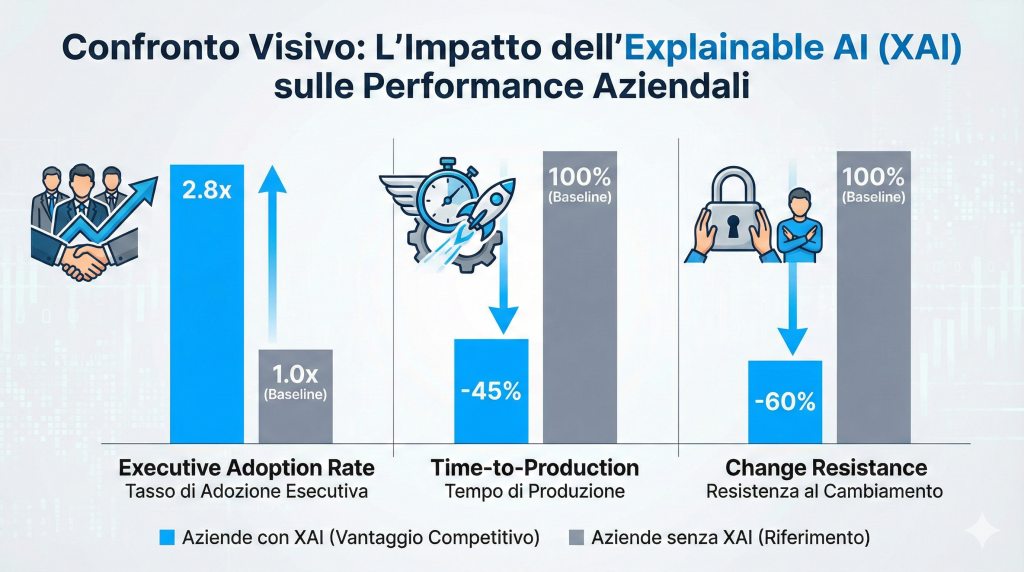
The impact of trust on business results is clearly documented. A study conducted by McKinsey in 2024 showed that companies that have implemented a structured Explainable AI framework see an adoption rate among executives two point eight times higher than those that haven’t. Additionally, they manage to reduce by forty-five percent the time needed to bring AI projects into production and encounter sixty percent less resistance to change from operational teams.
Risk Management: When AI Goes Wrong
Recent history has provided concrete examples of what can happen when artificial intelligence systems operate without adequate explainability. These cases are not theoretical speculations, but events that actually occurred causing significant reputational and financial damage.
In 2018, Amazon had to abandon an automated recruiting system because it systematically discriminated against female candidates for technical roles. The bias remained hidden for months precisely because the system operated as a black box, and when it finally emerged, the reputational damage was already done. Similarly, in 2019 Apple Card found itself at the center of a government investigation because its credit limit determination algorithm assigned significantly different amounts to men and women without any rational explanation. The case led to class actions and brand image damage.
More recently, in 2023, an AI system used for radiological diagnoses in healthcare showed a false positive rate of fifteen percent, with a particularly pronounced bias toward patients with darker skin. The result was not only billion-dollar lawsuits, but tragically also the impact on human lives that received incorrect diagnoses.
The common pattern in all these cases is clear: the lack of explainability prevented early detection of the problem. If the systems had been designed to explain their decisions, the biases would have emerged much earlier, during the testing phase or in the first weeks of deployment, when correcting the problem would have been relatively simple.
HOW EXPLAINABLE AI WORKS IN PRACTICE
After understanding why explainability is so important, it’s natural to ask how it works concretely. There are different techniques and approaches, each with its own strengths and ideal use cases.
LIME: Local Explanations for Every Decision
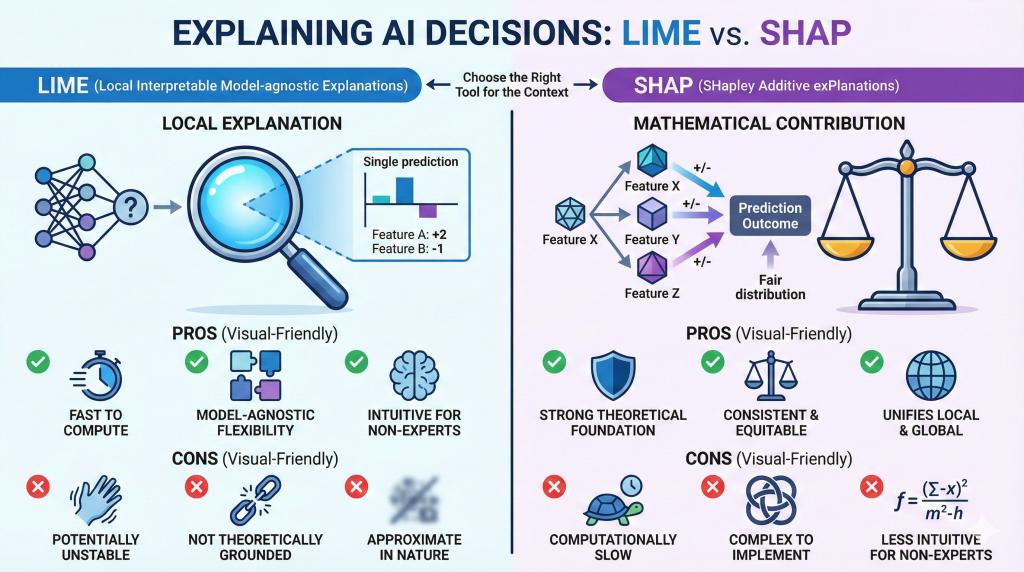
LIME, acronym for Local Interpretable Model-Agnostic Explanations, is a technique that focuses on explaining individual predictions by creating a simple, interpretable model around the specific decision we want to understand. Imagine wanting to understand why an AI system rejected a loan application for a specific customer. LIME would create a simplified model valid only for that particular case and show which factors most influenced the decision.
For example, it might reveal that the applicant’s annual income was considered too low, contributing negatively by thirty-five percent to the approval probability. The short credit history would have weighed in for an additional twenty percent negative, while high current debt would have influenced by fifteen percent. Conversely, employment sector stability would have contributed positively by ten percent. Adding up all these factors, the system arrives at the final rejection decision with sixty-five percent confidence.
The main advantage of LIME is that it works with any type of model, from the simplest to the most complex, making it extremely versatile. The limitation is that it provides a local explanation, valid for that specific decision, without necessarily illuminating the global behavior of the system.
SHAP: The Mathematics of Explainability
SHAP, which stands for SHapley Additive exPlanations, brings explainability to a more rigorous level from a mathematical standpoint. It’s based on game theory to calculate exactly how much each feature contributed to the final prediction. Think of SHAP as a system that fairly distributes the “credit” of the decision among all the variables involved.
Let’s take the example of a system predicting customer churn risk. The model might indicate a churn probability of seventy-eight percent. SHAP would explain that we start from a baseline, that is the company’s average churn, which might be forty-five percent. To this base value several contributions are added: the reduction in service usage in the last thirty days adds eighteen percentage points of risk, the three recently opened support tickets add eight points, the non-renewal of premium features contributes another twelve points, and receiving a discount offer from a competitor adds ten points. On the other side, the customer’s long tenure, five years in this case, reduces the risk by fifteen points. The net result leads to the final prediction of seventy-eight percent.
The great advantage of SHAP is its mathematical soundness and the ability to fairly attribute the contribution of each feature. The disadvantage is that it can be computationally expensive, especially with very complex models or very large datasets.
Attention Mechanisms: Where AI Looks
For neural networks, particularly those processing text or images, attention mechanisms offer an intuitive way to understand what the model is “looking at” when making a decision. Imagine a Document AI system analyzing a fifty-page contract and having to answer the question: “Are there penalty clauses in this contract?”
The attention system would show a heat map that highlights exactly which parts of the document captured the AI’s attention. We might see that page twenty-three, paragraph four point three, received ninety-five percent of the model’s attention, and there indeed is the penalty clause being sought. Page thirty-one, in a footnote, received forty percent attention because it contains a cross-reference to the same clause. Page twelve, a more general section, received only fifteen percent attention because it contains vaguely related terms but not the specific answer.
The system can then explain: “I found the penalty clause on page twenty-three, confirmed by a cross-reference on page thirty-one.” This visualization of attention makes the AI’s decision-making process immediately understandable.
[MEDIA 7: Screenshot Mockup] Description: Interface mockup showing a document with colored heatmap overlay. Areas “looked at” by the AI are highlighted with varying color intensity (red = high attention, yellow = medium, green = low). Includes sidebar explaining: “AI Attention: 95% focused on Page 23, Paragraph 4.3 – Penalty Clause Found”. Style: modern, professional UI/UX.
Decision Trees: Transparent Logic
Decision trees represent an approach to explainability that is inherently transparent. The logic is expressed in terms of if-then rules easily understandable even by those without a technical background. Consider a system that must determine production order priority.
The logic might be: if material stock is below the critical threshold of five hundred units, and sales forecast exceeds one thousand units per week, and supplier lead time is greater than ten days, then the order priority is urgent. Otherwise, if product margin exceeds forty percent and the customer is classified as premium tier, then priority is high. In all other cases, priority is normal.
When the system assigns urgent priority to order number twelve thousand three hundred forty-five, it can explain exactly why: current stock is four hundred fifty units, therefore below the critical threshold of five hundred; predicted sales are one thousand two hundred per week, therefore above one thousand; and supplier lead time is fourteen days, therefore above ten. All criteria for urgent priority are met.
The advantage of this approach is perfect interpretability. The disadvantage is that for very complex problems, decision trees can become too large and complicated to be truly understandable, limiting their applicability.
Counterfactual Explanations: What Would Have Been Needed
Counterfactual explanations adopt a different approach: instead of explaining why a decision was made, they explain what would have needed to be different to obtain a different result. This type of explanation is particularly useful because it’s immediately actionable.
Imagine a system that rejects a mortgage application. A counterfactual explanation might tell the applicant: “Your mortgage would have been approved if your annual income were forty-five thousand euros instead of thirty-eight thousand euros, so an increase of seven thousand euros or eighteen percent. Or, alternatively, if your current debt were eight thousand euros instead of fifteen thousand euros, so a reduction of seven thousand euros or forty-seven percent. Or again, if the requested mortgage duration were twenty years instead of twenty-five, so a reduction of five years.”
This type of explanation is extremely powerful because it doesn’t just say “no,” but provides a clear roadmap on what to do to get a “yes” in the future. The customer knows exactly which levers they can move to improve their situation.

IMPLEMENTING XAI: A PRACTICAL APPROACH
Understanding the techniques is important, but the real challenge is implementing them in a structured way within the organization. A pragmatic approach articulates in three fundamental steps.
Classify Systems by Risk Level
Not all AI systems require the same level of explainability. The first step is to classify your systems based on a risk matrix that considers two dimensions: the impact of decisions and the frequency with which they’re made.
Low-impact, low-frequency systems, like a chatbot answering generic frequently asked questions, require a minimum level of explainability. Basic technical documentation and disclosure to users that they’re interacting with an AI system is sufficient. Low-impact but high-frequency systems, like product recommendations in e-commerce, require a moderate level: it’s useful to show global feature importance, provide a model card with performance metrics, and indicate confidence levels of predictions.
High-impact but low-frequency systems, like strategic pricing decisions, also need moderate explainability with particular attention to decision traceability. Finally, high-impact and high-frequency systems, like those used in healthcare or for credit decisions, require the maximum level of explainability: every single decision must be explainable, there must be a complete audit trail, human review is necessary for critical cases, and there must be a formal mechanism to contest decisions.
Build an Explainability Workflow
Explainability cannot be an afterthought added at the end, but must be integrated into every phase of the AI model lifecycle. During the model development phase, it’s essential to accurately document data sources and preprocessing operations, trace all decisions made during feature engineering, test the model for potential biases across different demographic subpopulations, and generate global feature importance metrics.
In the validation phase, before deployment, it’s crucial to create a test set specific for explanations, verify that generated explanations make business sense, validate them with domain experts who can confirm their reasonableness, and test explanation consistency on similar cases. The documentation produced in this phase must include a detailed model card describing architecture, training data, and known limitations, a guide for interpreting outputs, a risk assessment with potential failure modes, and a responsible AI statement that explicates the principles followed.
During production, the system must generate real-time explanations for each decision. This includes the prediction itself, the confidence level, a structured explanation with main factors, any counterfactual explanations when appropriate, and references to similar historical cases. All this must be accompanied by a complete audit trail that records timestamp, model version used, input hash for traceability, and the operator who requested the decision if applicable.
Continuous monitoring is equally crucial. It’s necessary to track explanation consistency over time, generate alerts when anomalous explanation patterns emerge, monitor user feedback on explanation quality, and conduct in-depth quarterly reviews of the entire explainability system.
Design Human-AI Interaction
The world’s best technical explanation is useless if presented incomprehensibly. User interface design is fundamental to making explainability truly effective. Let’s compare two approaches.
An inadequate approach would simply show: “Decision: APPROVED. Confidence: eighty-seven percent.” End. The user has no idea why, which factors weighed in, if there were critical or marginal elements.
An effective approach instead would present: “Decision: LOAN APPROVED” followed by “Confidence: eighty-seven percent (High confidence)”. Then it would list the key factors supporting the decision: a strong credit history with a score of seven hundred twenty, labeled as the most important factor; stable employment of five years, an important factor; a low debt-to-income ratio of eighteen percent, also important; and a sufficient down payment of twenty-five percent, a moderately important factor.
It wouldn’t stop there, but would also include any minor concerns, for example a recent credit inquiry that had minimal impact, subtracting only two points. It would follow a “What This Means” section in simple language: “Your application meets all major criteria with strong financials. The recent credit inquiry had minimal impact on the decision.”
Even more useful, it would include a counterfactual section: “If the decision were different: Even with a credit score as low as six hundred eighty, this application would likely still have been approved given the other strong positive factors.”
Finally, it would offer clear options: “Questions? Contact your loan officer for details” with buttons for “View Full Analysis” and “Request Human Review.”
This difference in user experience isn’t an aesthetic detail, but the difference between a system that generates trust and one that generates frustration and suspicion.
MISTAKES TO AVOID
Even with the best intentions, Explainable AI implementation can go wrong. Knowing common mistakes helps avoid them.
The Illusion of Technical Explanation
One of the most frequent mistakes is what experts call “explanation washing”: providing explanations that seem technically impressive but actually don’t help understand at all. Telling a business user that “the model used a deep neural network with twelve hidden layers and ReLU activation function to generate embeddings of dimension seven hundred sixty-eight” may sound very scientific, but is completely useless for someone who needs to make a business decision.
An effective explanation would instead say: “We analyzed five key factors of your profile. The most important was your income, which represents forty percent of the decision, followed by your credit history which counts for thirty percent…” This is something the user can understand and act upon.
The solution is simple but often overlooked: test explanations with actual end users, not just data scientists. If a business user doesn’t understand, the explanation has failed its purpose, regardless of how technically accurate it is.
Information Overload
Another common mistake is going to the opposite extreme and providing too much detail. Showing all one hundred twenty-seven features used by the model with their relative weights when only five have real impact on the decision isn’t transparency, it’s noise hiding the signal.
The solution is to implement progressive disclosure: start with a summary of the three to five most important factors, then offer the possibility to explore additional details for those interested. Many systems implement a “simple mode” for business users and an “advanced mode” for analysts or auditors.
Post-Hoc Rationalization
This is a subtler but potentially more dangerous mistake. It happens when generating an explanation that “sounds good” but doesn’t actually reflect how the model arrived at the decision. For example, using a simple and different model just to generate explanations instead of explaining the complex model that’s actually making predictions.
The problem is that these explanations can be coherent and plausible, but if they don’t correspond to the true decision-making process of the model, they can hide critical biases or errors. The solution requires rigorous validation: verify that explanation fidelity actually corresponds to the original model, test explanation consistency on similar cases, and conduct regular audits by an independent team that verifies alignment between explanations and real model behavior.
Ignoring Uncertainty
The final common mistake is presenting predictions as “certain” when in reality the model has a high degree of uncertainty. Simply saying “Customer churn risk: seventy-three percent” without context can be misleading.
A more honest presentation would say: “Customer churn risk: seventy-three percent plus or minus fifteen percent. Confidence: MODERATE. Note: limited historical data for this customer segment.” This communicates not only the prediction but also how much to trust that prediction.
The solution always includes confidence intervals in predictions, properly calibrate probabilities through validation, and clearly flag when the model is operating outside its comfort zone, that is with data very different from what it was trained on.
TOWARD THE FUTURE OF EXPLAINABLE AI
The field of Explainable AI is rapidly evolving. Looking at the coming years, trends are emerging that promise to make AI even more transparent and reliable.
Causal explainability represents the next evolutionary leap. Instead of just identifying correlations, future systems will explain true causal relationships. The difference is substantial: instead of saying “shipping delay is correlated with customer churn,” a causal system will be able to confidently state “shipping delay caused customer churn, with a direct effect of twenty-five percent.”
Interactive explanations will transform explainability from monologue to dialogue. Users will be able to literally “converse” with the AI to deepen explanations. An executive might ask “Why does income have more weight than age in the decision?” and receive a detailed explanation of the underlying reasoning. This conversational approach will make AI much more accessible and understandable.
Multimodal explanations will recognize that different people prefer different learning modalities. The same decision could be explained with a textual executive summary for the CFO, interactive visualizations for the analyst, and detailed dashboards for the auditor. Each stakeholder receives information in the format most useful for their role.
Finally, we’re seeing objective explanation quality metrics emerge. Instead of relying on subjective impressions, we’ll be able to measure how faithful explanations are to the real model, how consistent they are over time, and how actionable they actually are for users. This will allow systematic optimization of explainability quality.
IMMEDIATE ACTION: WHERE TO START
After exploring the theory, use cases, and best practices, the natural question is: how to start concretely?
The first step, which can be done this week, is to conduct an audit of the AI systems currently in production in your organization. Which decisions are being automated? Which have significant impact on customers, employees, or operations? Which could be considered “high-risk” according to the EU AI Act definition?
In parallel, classify these systems according to the risk matrix discussed previously. Which require maximum explainability? Which can function with a moderate or minimum level? This classification will help you prioritize interventions.
The third immediate step is to talk to stakeholders. Interview executives, end users, and operational teams. What do they really want to know about AI systems? What questions do they ask when an automated decision surprises them? Which explanations would they find most useful?
In the first thirty days, choose one critical system as a pilot. Implement SHAP or LIME on this model, even if initially only internally. You don’t need to perfect everything right away: start with something functional that you can test.
Conduct user testing with ten real users. Show them the generated explanations and observe their reactions. Do the explanations answer their questions? Do they generate new questions? Are they too technical or too superficial? Direct feedback is pure gold.
Also create a documentation baseline: the first model card and the first explanation guide. Even if imperfect, they give you a starting point to iterate.
In the following ninety days, gradually extend explainability to all high-risk systems. Don’t seek universal perfection, but ensure critical systems have robust explanations.
Train your data science team on XAI best practices. Explainability must become an integral part of the development process, not a final add-on.
Establish a governance framework with clear policies on when and how to provide explanations, who is responsible for their quality, and how to handle clarification requests or contestations.
The final advice, but perhaps the most important: don’t wait for regulation to force you. Companies that proactively implement XAI build trust, reduce risks, and gain significant competitive advantage over those that only react when forced.
CONCLUSION: TRUST AS STRATEGIC IMPERATIVE
We’ve arrived at a turning point in the history of artificial intelligence. For decades, AI was a fascinating but distant academic research field from companies’ daily operations. In recent years, it’s become a powerful but often opaque tool, capable of extraordinary results but difficult to understand and therefore to fully adopt.
Today we find ourselves at the dawn of a new era: that of transparent and explainable AI. An era where computational power combines with human comprehensibility, where the most sophisticated algorithms can explain their reasoning in terms anyone can understand.
Explainable AI is not a technical luxury reserved for large corporations with unlimited research budgets. It has become a strategic imperative for any organization using artificial intelligence systems to make decisions that matter. Regulations require it, with sanctions that can reach tens of millions of euros. Executives demand it, refusing to base strategic decisions on systems they don’t understand. Customers deserve it, having the right to understand why an algorithm made a decision affecting them. And operational teams need it to trust enough to actually adopt AI recommendations.
The paradox we explored at the beginning of this article remains central: the world’s most powerful artificial intelligence is completely useless if no one trusts it enough to use it. You can have the most accurate algorithm, the most sophisticated model, the most precise predictions, but if they operate as an impenetrable black box, they’ll remain on paper instead of transforming your business.
Explainable AI solves this fundamental paradox. It transforms black boxes into trusted advisors. It converts fear of the unknown into reassuring understanding. It changes the question from “Why should I trust?” to “Now I understand why it works.”
The real question every business leader must ask themselves today is not “Can we afford to invest in Explainable AI?” The real question is “Can we afford NOT to?” In a world where algorithmic transparency is increasingly required by law, demanded by customers, and necessary for internal adoption, the answer is clear.
The future of AI isn’t just more powerful. It’s more understandable. It’s more reliable. It’s more human.
And that future starts with the choices you make today.
USEFUL RESOURCES
To further deepen the topic of Explainable AI, we’ve collected some fundamental resources that can guide your implementation journey.
On the technical frameworks and libraries front, SHAP is freely available on GitHub and represents a de facto standard for Shapley value-based explanations. LIME, also open source, offers a model-agnostic approach that’s particularly useful. InterpretML from Microsoft provides a complete suite of interpretability tools, while Captum is the dedicated solution for those working in the PyTorch ecosystem.
Regarding standards and guidelines, the full text of the EU AI Act is available on official European Union sites and represents mandatory reading for those operating in the European market. The ISO/IEC TR 29119 standard provides technical guidance on AI Explainability. The NIST AI Risk Management Framework offers a structured American approach to AI risk management.
Among recommended readings, the book “Interpretable Machine Learning” by Christoph Molnar is freely available online and represents perhaps the most comprehensive resource on the topic. “The Alignment Problem” by Brian Christian explores the broader challenges of alignment between AI and human values. “Weapons of Math Destruction” by Cathy O’Neil offers a critical and necessary perspective on the dangers of opaque algorithms.